Generation 1
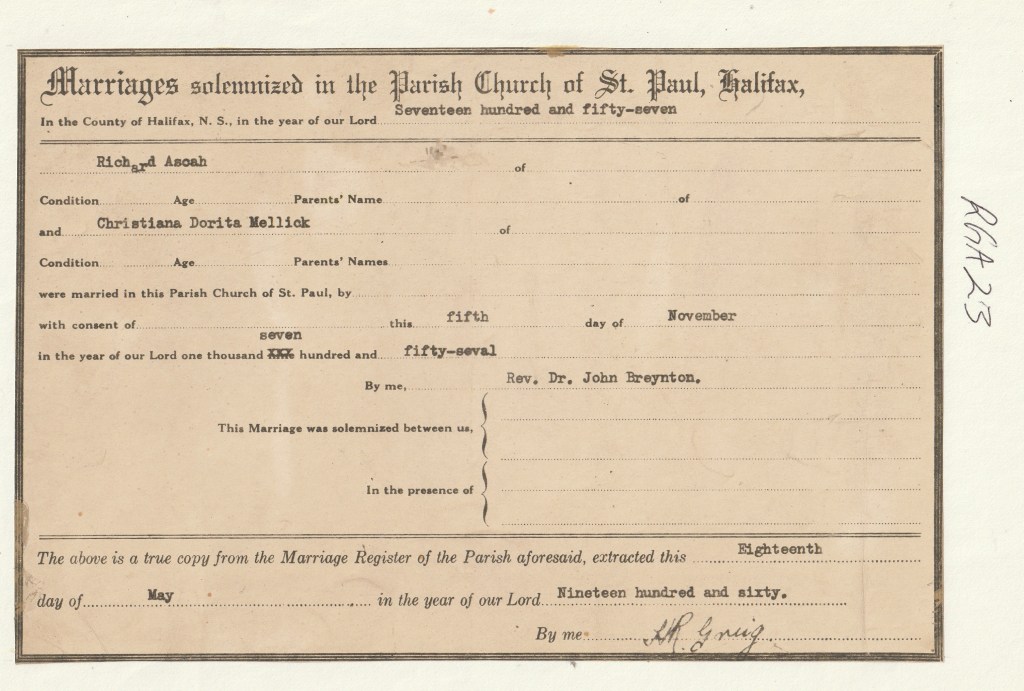
Note- this is a Post in progress. There are quite a few unanswered questions concerning Generation 1 of the Ascah clan. There are many missing pieces of information to confirm place of death, birth, marriage dates, etc. which Chart 1 of the family tree have yet to be identified. I have access to Ancestry.ca and they provide hints in the form of documents that may hold the answer attached to a particular Ascah or spouse. Unfortunately, many of the records are extremely difficult to read (example below), making identification challenging. There are many other sources including genealogies of related families (e.g. Patterson, Annett, Coffin, etc.) and if you happen to have access to a promising source to confirm dates or places, please send me an email at ascahll@gmail.com.

Emigration
What kind of place did Richard and Christianna hail from Europe/Britain in the 1730s? What encouraged them to move to the “New World”? Was it a higher standard of living, avoiding grinding poverty, local wars or unemployment? Given both were illiterate, unknown “prospects” may have been much better than known prospects. This is a classic emigrant story.
From Ancestry.ca I have been able to obtain a “hint” about Christianna’s birthplace. There was an Aaron Mellick (Moelich) who emigrated from Saxony, Germany in 1735 with his family to Philadelphia. Records show Christianna was not a member of this family. However, this hint is suggestive that the Christianna came from Germany.
Unanswered Questions
Since the first two generations of Ascahs were essentially illiterate, there are recorded journals or letters written that would give a flavour of late 17th century life in Gaspé.
- What must it have been like to emigrate from Europe to North America in the mid-18th century?
- What must it have been like to be dropped off on the shore of Peninsula Point with an axe, musket, building tools -husband, wife and young daughter?
- How daunting must it have felt to survey the dark coniferous forest above the Point realizing the perils of settling in this silent, remote place?
- How did they survive their first winter before supply ships could come into the Bay the following summer.
- What dreams did Christianna and Richard share about the future of their emergent family?
Journey over
After each decided to emigrate and where to emigrate to, they had to acquire funds for their transport across the Atlantic. That said, it is quite possible both Richard and Christianna came to the new world with their families in the period of 1730-1750.
According to GOOGLE Gemini (which may not be the most reliable source), steerage passage cost two or three year’s wages of a basic labourer! The passage at this time could be viewed as having similar risk as space travel today or travelling by air over the Atlantic 120 years ago. But first, they also had to travel to an ocean port with routes to their planned destination.
The main departure ports for emigrants leaving Europe included Hamburg, Bremen, Goteborg, Liverpool, Belfast, Dublin, Rotterdam, Southampton, and Le Havre.
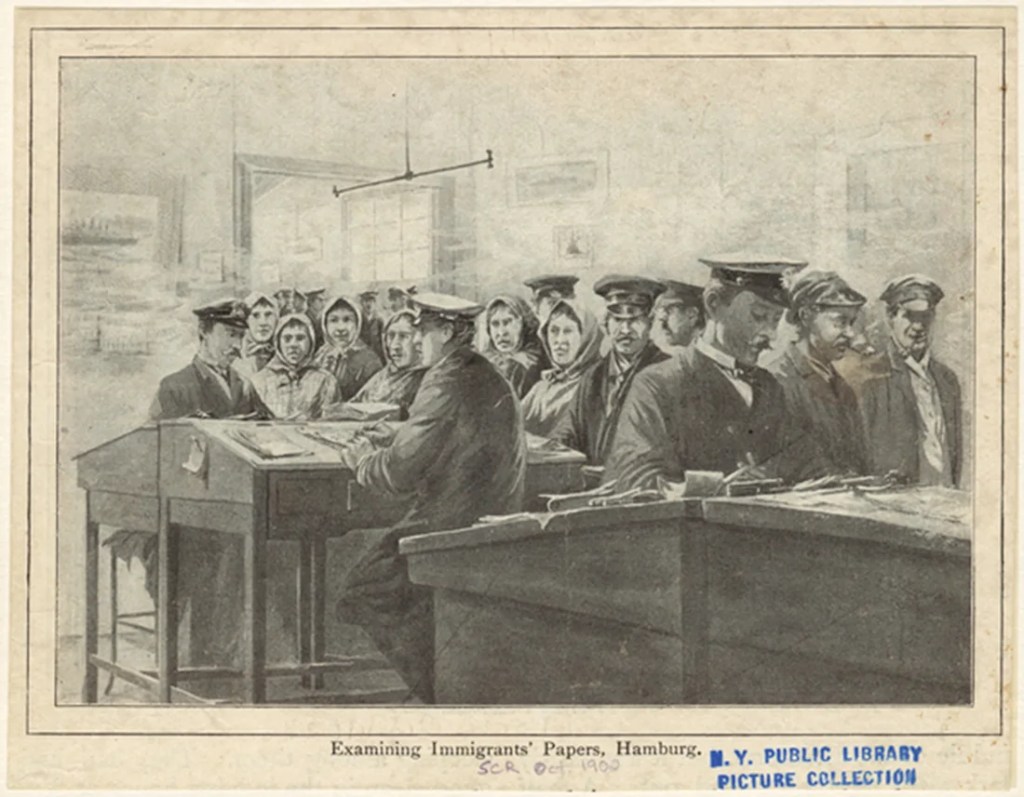
Source: New York City Public Library Picture Collection https://www.europeana.eu/en/exhibitions/leaving-europe/departure-and-arrival
Sailing times varied depending on the port of departure as well as the ship’s size, number of sails, the shape of the hull, and whether the ship was cargo, light cargo, or a warship. The voyage was usually between 25 and 30 days, although one source suggests travel took between 40 and 90 days.
In a diary published in 1898, Gottleb Mittelberger (Eyewitness to History.com) observed:
“…during the voyage there is on board these ships terrible misery, stench, fumes, horror, vomiting, many kinds of seasickness, fever, dysentery, headache, heat, constipation, boils, scurvy, cancer, mouth rot, and the like, all of which come from old and sharply-salted food and meat, also from very bad and foul water, so that many die miserably.
Add to this want of provisions, hunger, thirst, frost, heat, dampness, anxiety, want, afflictions and lamentations, together with other trouble, as e.g., the lice abound so frightfully, especially on sick people, that they can be scraped off the body. The misery reaches a climax when a gale rages for two or three nights and days, so that everyone
believes that the ship will go to the bottom with all human beings on board. In such a visitation the people cry and pray most piteously.”
If alone on the voyage, how did Richard and Christianna pay for the fare? Did they become obligated for some kind of service like a maidservant or indentured farm labour?
During the 18th century 80 per cent of German emigrants came through the port of Pennsylvania (Philadelphia) and many moved to Maryland and Virgina. Indentured labour in the tobacco fields of Virginia was a common feature for paying off the trans-Atlantic fare. Virginnia planters employed both African slaves and indentured labour. In the 1700s this method of paying for the fare was not uncommon especially for German youth leaving the continent. Unfortunately, times have not changed dramatically where human trafficking and exploitation of immigrant labour remain all too common.
According to a letter dated 2 March 1968 from my Uncle Elmer to his first cousin Dr. Geoffrey Ascah:
I am now fairly well persuaded that the name is Germanic in origin and that Richard was with the 60th Royal American Regiment of Foot. The muster rolls of this regiment only go back to 1780 in England, but they suggest that as the regiment was raised in America in 1756 that the original muster may be in Washington…. I am told that the 60th was composed of Dutch & Germans mostly recruited its officers in Virginia and New England with English officers. The 2nd & 4th battalions were at Quebec and the 4th batt. remained after 1759 as part of the garrison (emphasis added).
During the period under consideration emigration was particularly strong in 1727, 1732, 1738, 1742-1744, and 1749-1754. These flows were dependent on whether wars were being fought which would reduce emigration. Another factor were “incentives” and “privileges” offered by the Russian or Austrian empires to lure peasants east.
During the years 1749-1755, 2700 Germans landed at the Port of Halifax. This may have been the route which Christianna followed.
Richard departed from Virginia with this British-America battalion in the early 1750s and when stationed in Halifax must have made acquaintance with Christianna. They were married in the Parish of St Paul’s, Church of England on 31 December 1757.
In preparation for the assault on Quebec, the British Navy conducted raids on French settlements burning their homes and fishing equipment. According to an article by Dorothy Phillips in Revue de la D’Histoire Gaspésie (Vol VIII, 3, Juilliet-Septembre 1970, pp. 125-136), on 10 and 11 September 1758, General Wolfe’s men burnt “everything in the settlement on the Point.” There would be no love lost between the French settlers and the English for the next 200 years! After the attack, Wolfe and his men sailed for Louisbourg. We do not know whether Richard Ascah was a part of this expedition, if not, he may have been intrigued by stories of Gaspé Bay.
The next record we have is the list of members of Lieutenant General Peregrine Lascelles 47th Regiment of Foot dated 4 October 1760 where Richard Ascah is listed as a corporal.
After the famous storming of Quebec’s Citadelle, Richard and Christianna stayed on at the Québec garrison. On 8 April 1763, Hannah (Hanna) Ascah was born in Fort Michels. I am not able to determine the provenance of this fort but presumably it was a fort located near Quebec City. This would be the last time for this generation of Ascahs to have access to medical birthing assistance.
The Ascahs were dropped off in the summer of 1764 on Peninsula Point by the Royal Navy. There must have been settlement plans drawn up by the administration of Governor James Murray and Gaspé at the mouth of the mighty St. Lawrence held some strategic value. Soldiers serving in the army were viewed as loyal to the Crown, skilled and dedicated and worthy recipients of land grants to settle in this area. At this time, other anglo-settlers in Gaspé included the Annetts, Millers, and Coffins.
The first English-born baby in the “Port of Gaspey” was Robert or Bob Ascah, born on 11 December 1765. This delivery for Christianna must have been challenging with few women to act as supports and limited medicines, if any, to address complications.
On 23 or 26 February 1768, Margaret or Margarita was born followed by Martha on 10 December 1770. Four years later Richard (I will call him Richard II) was born and five years later the last of the first generation of Gaspésian Ascahs was born- John (James) (See chart 1).
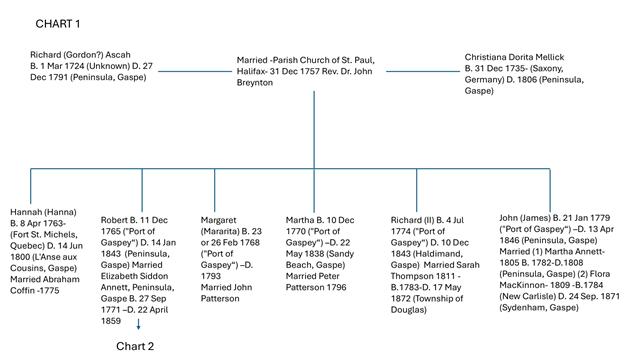
The above first-generation tree documents the marriage dates and names of the brides and grooms. Several elements stand out. Hannah married very young to Abraham Coffin in 1779 at the age of 16. She lived only 37 years dying in L’Anse aux Cousins on 14 June 1800.
Robert married Elizabeth Siddon Annett for which I did not find their date of marriage. Elizabeth and Bob remained in Peninsula all their lives.
Her sisters Margaret and Martha married into the Patterson clan, Margaret being 25 and Martha 26. We know the year of these nuptials but don’t know the specific dates.
Richard II married Sarah Thompson in 1811 and moved to the south side of the Bay where he died in 1843; Sarah lived to the ripe old age of 89 but their stories will be told later.
 AscahGenealogy.com
Leave a comment