In 1944 Robert William Laurence Ascah (1911-1977-my dad Larry) was trained as a navigator to fly missions ultimately in Burma. I am very indebted to my cousin Barbara (daughter of Christina Agnes 1916-2007) who passed on this correspondence to his older sister Constance Clara Ascah (Connie- 1909-1996).
There are 17 letters in this treasure trove concentrated between 1944 and 1946. Especially for families with “men in uniform,” the war situation must have been one of great anxiety as families huddled around their radio sets listening to the latest news. Would the Fuhrer be defeated and what of the Japanese who had established themselves throughout South-east Asia, Korea, and China? By the time my Dad arrived in Burma, the allies were steadily advancing on Berlin from east and west and it was a race to reach Berlin.
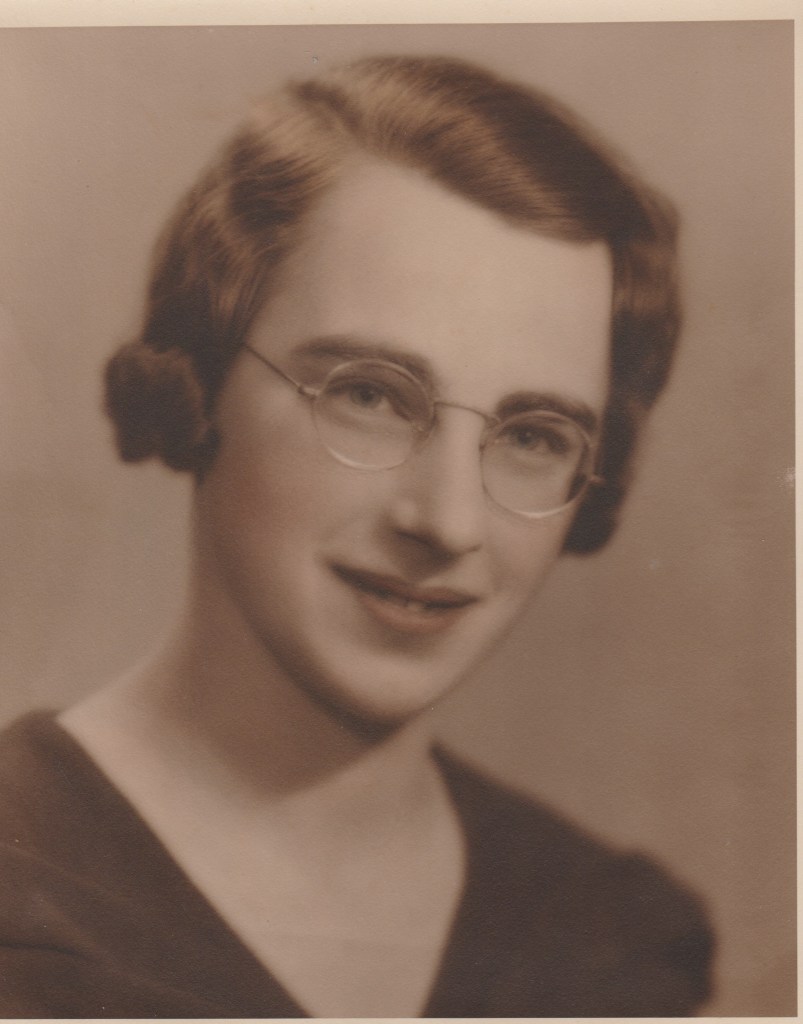
Constance Clara Ascah- photo courtesy of Barbara and Wayne Harrigan no date.
Canada to England
His first letter to my Aunt Connie was written at the end of November 1942 from Jarvis Ontario which is located in Haldimand County in southern Ontario, between Toronto and Windsor with nearby towns being such metropolises as Simcoe, Cayuga, Port Dover, Townsend, and Hagersville. He writes: “Have been here three weeks and can’t say I have learned a great deal. They seem to spend a lot of time doing nothing, although I have had to work 7 days a week and every second night.” He noted that they should be flying in a week and that he has learned “most of our theory.”
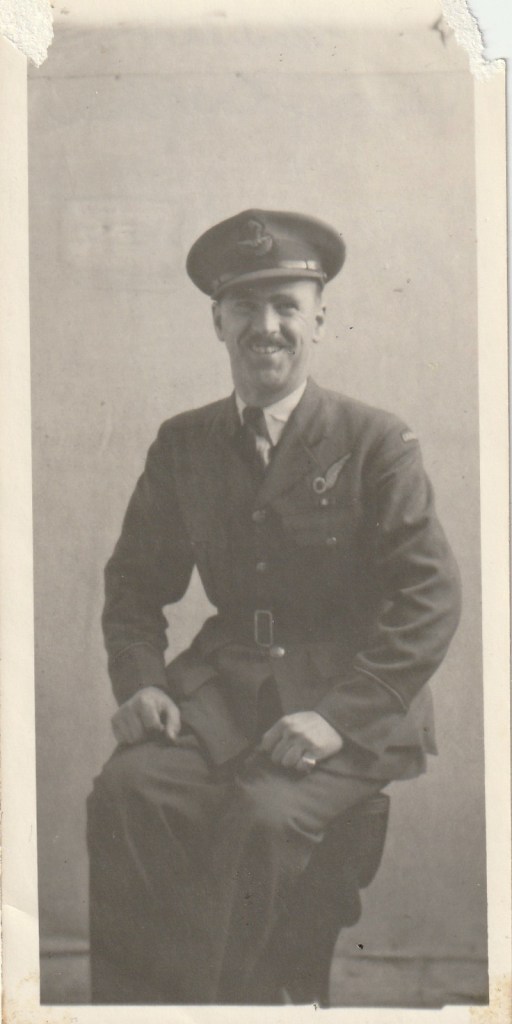
Airman Robert William Laurence (Larry) Ascah circa 1943
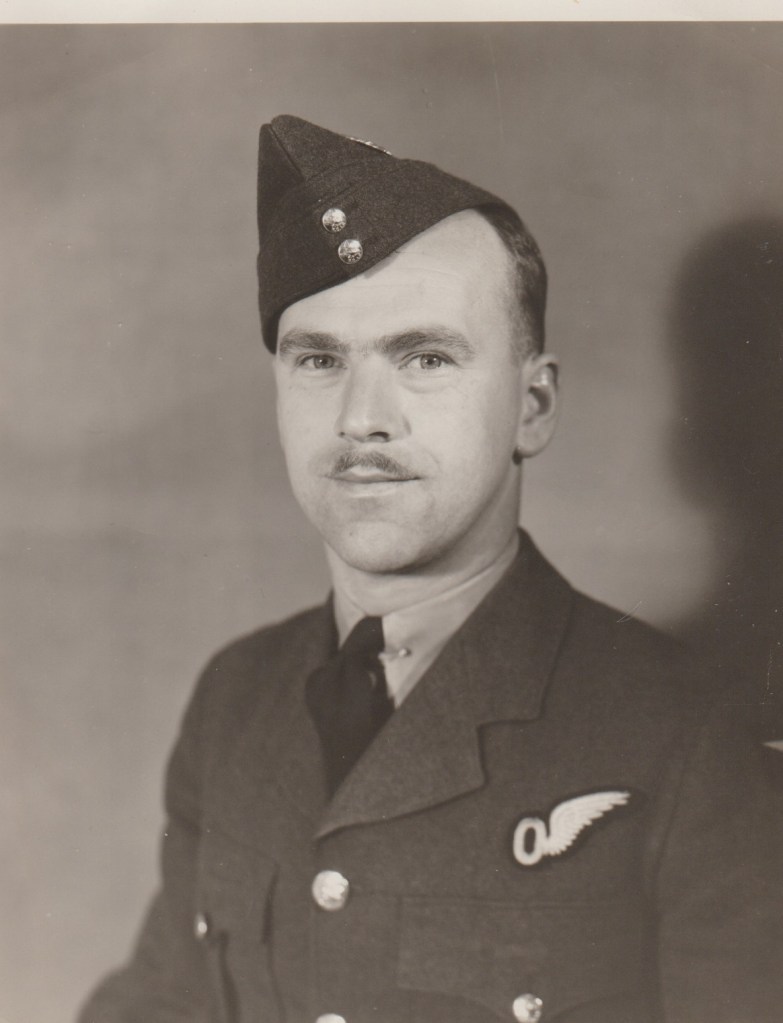
Larry Ascah in uniform RCAF navigator (circa 1942-43)
He continues –“Have lots of fun, taking in a few of the night clubs. Quite a novelty from the Western cities, in which there is a dearth of such entertainment.”
He mentions his experience with a turret gun firing “75 bullets per second.” He speaks of a two-day leave which allowed Larry and some mates to hitchhike to Buffalo, N.Y. Finally he adds that he received a letter from his father Lewis McGregor Ascah (1869-1961) which was censored –“they must be getting very strict down there.’ He notes his next posting was likely to be Chatham, Ontario.
The next communication was not until 8 September 1944 in a telegram from Larry’s first wife Chrissie (Lawson- died in 1946) who advised Connie that Larry had arrived safely in Britain and she had also advised his father Lewis.
That same day in a letter to his sister he says he didn’t get seasick on the way over. He regrets not being able to say good-bye to her but “they shoved us off in such a hurry.” He has a favourable first impression of England-
The fields are marvelously green and the rock gardens and landscaping on the large houses in public parts etc. are grand. The houses look quaint as they all have chimney parts with 4 or 5 chimneys sticking out of them exactly as in the picture postcards.” He finds the costs of goods very high “seeing peaches at 5/9 (shillings/pence) each so you can see what it would cost to have peaches and cream for dessert.
In October 1944, he begins stating how “much appreciated” Connie’s and other correspondence are. He is also appreciative of Connie going down to see Chris, his wife, leave for the West by train. Larry is now in the Midlands which gives him the opportunity of flying again. He refers to his air mates Sandy and Hal Ward (wonder if there is any relation to Max Ward, though Dad never mentioned it) who arrived and were given a week’s leave. He mentions a trip to watch the dog races.
It’s quite the sport over here and run on much the same lines as horse races at home, as we soon found out after parting with a number of sheckles. I managed to cash in on a couple of tickets though.
On 13 November 1944 Larry writes concerning missing Thanksgiving-“I would sure liked to have been there for your party, the sound of Dewars Scotch makes me a bit homesick as that sort of stuff is quite scarce over here and what you can get hold of is quite expensive.” He adds that he expects to be posted elsewhere but had no idea where that posting would be. The weather he describes as damp and “raw,….. most of the time with lots of rain and mud which makes almost impossible to clean your shoes clean.”
On 15 December 1944 he writes regretting he would not be home for Christmas. Larry was at a “holding unit” ready to be dispatched overseas.
The place we are in is a summer resort and not very lively but at that I may stay here as they have some good play opera etc. coming so may go Ritzy and patronize the arts.
In addition, he travelled to Edinburgh on leave, then on to Inverness to visit his wife’s relatives observing
However yet being winter time and the house is heated with the inevitable fireplaces I found it a bit uncomfortable at times. Edinburgh is a beautiful city, it being the capital of Scotland, it has many fine buildings and quite a number of attractions for tourists. I went on a couple of tours and saw several of the places where bloody plots were hatched or executed. The Inverness country is very rugged but quite bleak this time of year, the day was clear for my trip up so was able to soak up the scenic parts of it.
The first overseas letter to Aunt Connie was written on 28 December but references his last weeks in England. He references a tremendous snowstorm suffered by Montrealers just before Christmas. He also references Camillien Houde’s victory as mayor of Montréal- “Well I must say I don’t either (like election of Houde) and don’t think much of the people of Montreal for putting him in.” Houde was known as an anti-semite and was nick-named the “unpredictable.” Houde was mayor of Montréal from 1944 to 1954.

Camilliien Houde Source: Centre d’histoire de Montréal
Larry received a lot of parcels for Christmas coming from his sister Muriel (Wallace-1906-1988), his eldest sister Joyce (1904-1985), his father, the Comfort Fund of Peninsula, and the Commercial Travelers association. He also received several packages of cigarettes (Larry was a salesman for Imperial Tobacco resuming his career in 1946 until 1976). He and his air-mate Sandy were invited to a private house and had a very enjoyable evening.
It was a young couple who wanted to do their bit for some strangers in a strange lands and they did … pound with roast goose, plum pudding etc.” He adds “Have enjoyed my time here as we have had nothing to do and we were living in a boarding house which was fairly comfortable but cool most of the time. Here taking in several shows and attended three of Gilbert and Sullivan opera put on by a very good company.
India and Burma
On 17 January 1945 he writes he is “basking in the warm India sunshine.”
“Have just come in from playing a game of softball against the N.C.O’s (we won) and will probably be nursing a nice sunburn tomorrow.”
“We left England on Jan 1st and arrived here on the 7th which is quite speedy traveling considering we spent a day in Italy and one in Egypt. I was able to get into Cairo, six of us went together and hired Dogeman to take us around to see the sites; he took us to see the mosques, marvelous buildings with most elaborate decorations, all inlaid with mother of pearl and ivory, there’s nothing in the western world that can remotely compare.”
He concludes by saying he is not impressed with the local food or its cost in rupees.
On 17 February 1945, he observes they “had done nothing” since arrival from Leicester. He informs his sister that he has been posted to a Canadian squadron noting “it is almost a relief” to be working again.
“We are well bushed here and I should be an expert in jungle life when I leave.” According to the letter they were living in a grass bamboo hut with spare furnishings and the men were sleeping on “Stretch sacking.”
He tells her the food is as good as can be expected for army ratios with plenty of “bully beef” (canned corn beef). He was not terribly pleased about this diet and was happy to get some decent food at a party for the airmen.
“I had a few days in Calcutta on the way here, it’s quite a city but very expensive for white folks. The next time I go I think I’ll buy myself a sheet, I’ll be dark enough then to pass as an Indian. They have some great marketplaces there and it’s fun wandering through them and haggling over prices even if you don’t buy anything. They always ask twice the value of an article to start with, you offer him half the value when after 15 or 20 minutes you can sometimes come to an agreement, they usually get the best of the bargain though.”
On 11 March he writes about receiving parcels from Connie and his wife Chris. He expresses his heartfelt appreciation for the parcel. Packages are very often shared and chocolate is a particular favourite. He was pleased to get a letter from Connie commenting “keep them coming,” and saying these packages are the “best morale builder.” He notes that the days are getting hotter and the mosquitos “out of their layers and concentrate their efforts on us poor unfortunates, we put our mosquito nets down before dark usually but there are usually some inside so we have to kill them off before going to sleep.” He adds that his pal Sandy is sick in the infirmary with jaundice. He tells a story about Kite hawks who swoop in to grab airmen’s lunch from their plates being carried from the cookhouse to mess. “I was walking behind Bob our copilot when a hawk swooped down, grabbed his meat and and a potato and was away again. I never saw a guy look so surprised you could have driven a horse in his mouth.”
In his letter of 2 April 1945, he references a letter from Connie received in March describing her trip to Farnham where he observes from her letter that “you didn’t have to spend much time at the Rectory.” Farnham is a small industrial town in Québec’s Eastern townships 65 kilometres southeast of Montréal. This would be in reference to their Uncle Gordon or Clifford, both Anglican ministers. In the letter he muses about getting to come home, noting the weather is very hot although the nights are cooler given the elevation. He references an E.N.S.A. entertainment that he wouldn’t pay money for back in Canada. He observes there were “5 girls” in the show “who wore shoes and is the first we have seen since we came up to this neck of the woods.” He goes on to talk about the war in Europe saying “”it shouldn’t be many more days before Germany is washed up.” He laments the fact he won’t be home to celebrate the coming victory. Germany surrendered on 7 May 1944 in Reims France and on 8 May 1945 in Soviet Military Headquarters, in Berlin-Karlshors. He concludes the letter referring to a visit to Mandalay.
In his letter of 4 May, he describes the heat when the sun is overhead “as an effort to even walk outside.” He heard the thermometer was 135 degrees Fahrenheit when placed in the sun. He mentions that his group watched a couple of movies “quite old,” and an E.N.S.A. show- “The show was quite poor but at least the artists tried hard.” He explains that he is an “orderly” that day- “a Joe job, I have to make an inspection tour of all the camp and check the meals etc.” About the war, he tells Connie that “we had entered Rangoon which is the last job stronghold in Burma so this campaign shouldn’t be too long in ending.”
On 26 May he advises that he just returned from Calcutta (Kolkata) where he was on “temporary duty.” He describes the weather there as “sticky” and at night it did not cool off – “The water would just pour off one even when lying on the bed without a sheet.” He tells of a trip to the British and American Club for dinner which served “the best food I have had since I left Canada… The bill was a bit steep – 103 rupees.” Larry also attended a Hindu burial ceremony where the ashes are thrown to Mother Ganges with the blessing of the priest.
I saw a few of them (Indians) in the water and was it filthy, they were ducking their heads and washing their mouths with it and while I was there I saw bloated cow or horse floated by within a few feet of them. It’s no wonder the lifespan is short.
On 22 July he writes about hearing that George (Ascah?) arrived safely home, hoping “that he is feeling well after his ordeal. I’m sure they couldn’t have been treated any too well if all the report about the concentration camps are true.”
He had returned after two weeks leave in Darjeeling –
It’s a hill station where the British Gentry send their wives for the hot weather in peace time. It is really a beautiful spot, 7000 feet above sea level and built around a mountain. Roads are built up with rock and zigzag all over the place. Yet isn’t as good just now as clouds surround the place quite a bit of the time, however it was quite cool which was a great relief from the heat of the plains.
Larry notes that Connie is going home to visit her Dad and hopes that Ernie will be there and wishes he could be there too. This letter was written several weeks before the Japanese surrender in mid August.
At the beginning of October, he is writing from Bournemouth England waiting to come home. He says his report number is ’91’ and
I see from the Maple Leaf that all those from Transport Command under 95 are on the report list. They were looking for more Navs to carry on with the squadron here but needless to say I didn’t push forward. We were very busy up until we left Burma, we were one of three crews ordered attached to a forward area supplying the troops cut off by the Japs and it was the toughest work we did the whole time we were there, the weather was at its worst and the area was a mass of mountains. We flew our own aircraft back, leaving Burma on September 11th and arrived here on the 16th which was pretty good slugging seeing we down around Arabia by way of Aiden. The weather was good the whole way which made it much nicer.
Long voyage home… waiting
On 2 November he writes from Bournemouth reporting that there was a change in the methodology on who got top go home first.

Left to right Larry, navigator; Sgt Bishop, wireless, air gunner; Sandy McLeod, pilot, last person’s name not known- was a sergeant, wireless, air gunner
We are packed to the hilt here but there is supposed to be a large draft going on December 2nd which I am hoping to make, if so I should be in Montreal by the 9th of November. I wrote Dad suggesting he come up to Montreal and promised to pay all his expenses if you would get him a hotel room but he wrote he wasn’t as young as he was when last in Montreal so didn’t feel up to it. I would like to go down but I feel I have to get back to my civilian life as soon as possible. I’m glad to hear you have been having such a full social life, your bridge must be improving seeing you are getting all the prizes.
In his penultimate letter, again from Bournemouth, written on 17 December he wishes his sister “and your fellow apartment dwellers” a merry Christmas.
I’m hoping to get on the first boat after the new year, they are taking up tp 90 and the coming draft is on December 28th so as I’m 91 I should certainly be on the next one. I hope the weather won’t be too rough going home and as I can as I still recall how seasick I used to get going out with Uncle Ab to the nets “years” ago.
But Dad still did not get on a ship crossing the Atlantic. On 4 January 1946 he is still stuck in Bournemouth. How agonizing the wait must have been. He plans on staying in Montreal for a couple of days to see the “folks” before going out West.
Don’t get the bright idea of pawning me off on any of the relatives so. I’ll give you a ring when I get in call mom anyway you will probably see from the papers when we disembark.
What a gift to write these letters which give an insight into what life was like as an RCAF airman. The joys of receiving letters and parcels, the chance of seeing very different parts of the world and their cultures. How hard it would have been to miss Thanksgiving and Christmas. The desire to soak up as much news from the relatives which Connie could provide as his sibling only could.
Again, I am deeply indebted to Barbara Harrigan for passing on both these informative letters and pictures.

 AscahGenealogy.com
Leave a comment